
Where to Place a Floor Lamp in a Living Room
Place a floor lamp according to the job it needs to do: beside seating for reading, near a dark corner for ambient light, behind a sofa to replace a side table, or beside a console to balance the room. Then verify the base footprint, shade position, walking clearance, outlet and cord path.

Map Existing Light First
Observe the room during the day and after dark. Mark ceiling lights, windows, table lamps, television glare, artwork and corners that remain dark. A floor lamp should fill a specific gap rather than add brightness without purpose.
Record furniture and outlet locations on a simple plan. Include recliner movement, sofa pull-out mechanisms, door swings and common walking paths.
Beside a Sofa or Chair
For reading, place the shade near shoulder level and slightly behind or beside the reader so light reaches the page without shining directly into the eyes. Check the position from every seat the lamp serves.
The Etta Floor Lamp is 57.09 inches high with a 19.69-inch shade diameter and horizontal arm. Its shade extends away from the central stem, so the arm and shade—not only the base—determine clearance.
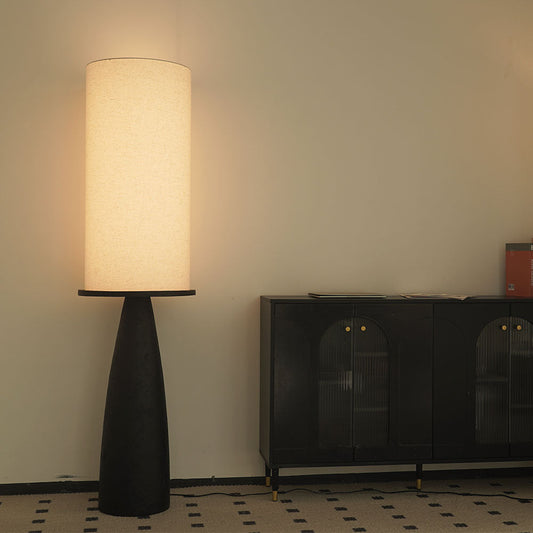
For ambient light beside a sofa, a drum shade can distribute light broadly. The Amande Floor Lamp is 69.2 inches high with an 18.1-inch diameter. Its vertical silhouette uses a different footprint from an arched or extended reading lamp.
Behind a Sofa
A slim lamp behind the sofa can add height without consuming side-table space. Measure the gap between sofa and wall, base diameter, shade width and access to the switch. Keep the shade from touching curtains or upholstery.
Check whether the lamp can be reached without pulling the sofa forward. A foot switch hidden under furniture is inconvenient and can lead to cord strain.
In a Dark Corner
Place an ambient floor lamp far enough from both walls that the shade can spread light and the base sits flat. Moving it a few inches changes wall brightness and shadow shape. Use removable floor tape to test positions.
A corner lamp should support the room's main lighting, not become the only safe circulation light. Verify paths to doors and stairs separately.

Near a Console, Art or Plant
A floor lamp can balance a console or vertical artwork. Compare the full lamp height with the object rather than centering the base mechanically. Keep bulb heat and shade surfaces away from plants, fabric and paper.
If the lamp casts light onto art, check glare on glass and color consistency with other accent lighting. Do not assume every shade produces a controlled art-lighting beam.
Protect Walking Paths
Mark the base and widest shade or arm on the floor plan. Maintain a clear route around the lamp. In a narrow room, a heavy round base may be safer than a projecting tripod, but the actual stability and dimensions matter.
Place cords along walls or approved covers, not diagonally across traffic. Include the plug body and any dimmer or foot switch in the cord plan.
Consider Television Reflections
Turn on the lamp and view the television from each seat. A bright shade can reflect on the screen even when the lamp is behind the viewer. Shift the lamp, lower brightness or change shade direction before finalizing.
Avoid placing an exposed bulb directly in the peripheral view beside the screen. Layered lower-output sources often work better than one very bright lamp.
Place Lamps in Open-Plan Rooms
In an open living and dining area, assign the floor lamp to the seating zone rather than centering it in the whole room. Use the back of a sofa, rug edge or console as the visual boundary, then check that the lamp does not narrow the route between zones.
View the lamp from the dining table and kitchen as well as the sofa. A tall shade may align well from one angle but block artwork or sightlines from another. Coordinate its color temperature with nearby dining and kitchen lighting so the connected space remains coherent after dark.
Choose Reading or Ambient Output
Reading lamps direct light toward a task and benefit from adjustable shades or arms. Ambient lamps spread light through or above a shade. Some fixtures do both, but verify the real beam and control range.
Read the Reading vs Ambient Floor Lamp Guide before choosing a fixture for a specific seat.
Living-Room Placement Worksheet
| Check | Measurement or decision |
|---|---|
| Task: reading / ambient / accent | ___ |
| Lamp height and base footprint | ___ / ___ in |
| Shade width and maximum projection | ___ / ___ in |
| Distance from seating | ___ in |
| Walking-path clearance | ___ in |
| Outlet, cord and switch route | ___ |
| Screen or framed-glass reflection | pass / revise |
| Other lighting layers | ___ |
Test the full-size outline and cord route before purchase. Browse Floor Lamps and Living Room Lighting after assigning the lamp a specific job.
Tags:
Related articles
Nature’s Geometric Light
Aug 16 2026
Organic Texture for Warm Interior Lighting
Aug 15 2026
Sculptural Light, Craft Timeless Home Ambiance
Aug 08 2026